
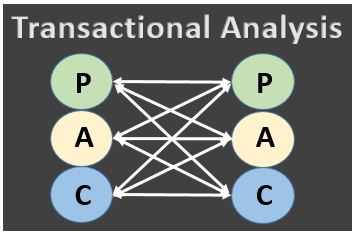
I have been very fortunate to be exposed to Transactional Analysis (TA) techniques very early on, in my professional career – as a means to understand and deal with relationships. It has been my north star, in developing and managing all types of my relationships – personal and professional. Refer my previous blog posts on Relationships – which identifies key and routine relationships. Once familiar with the TA techniques, if you carefully apply them to your key and routine relationships – you will see definite results. Eric Berne developed the concept and paradigm of Transactional Analysis in the late 1950s. You will find interesting reading material on-line, if you wish to dig deeper.
Everyone has 3 Ego states (Parent-Adult-Child), and one of 4 life positions in relation to oneself and others (I’m OK and You are OK….. and other combinations thereof). Think of Ego states as a dynamic status of your emotional existence, at any given point in time. So you and the people around you are in their own Ego states, depending upon their current mental and relational positions. Ego states are transitory in nature, exhibited by how everyone currently project themselves. Compared to this, life positions are longer term in nature and exhibit a certain permanence. For peaceful co-existence, you want to create your personal and professional environments as “I’m OK and You are OK”. Any position, other than this will create strife and cause hurtful emotions.
Parent Ego state – is when one’s behavior exhibits power positions/figures, like a parent, uncle, teacher, employer….. anyone in a position of authority. In most cases, when one is in the Parent state, the other person they are interacting with is forced to their Child Ego state. By nature, Parent state can be very subjective. The Parent state exudes power and control and uses their power position to manipulate, scare and dominate the other person. It is very important to quickly identify, if you are being forced into your Child state, so you can prevent yourself from getting hurt. At the same time, be cognizant of when you slip into the Parent state periodically. Think back to your tender childhood years when key Parent figures in your life, controlled your Child state, and help create the emotional structure for the Child Ego state in your adult years. I do not want to tag the Child state negatively…. Rather it is the Parent state, if used in any way other than nurturing….. can create a very damaged Child state for the other person
Adult Ego state – is when one’s behavior is dealing with factual data in a very objective manner. In almost all cases, when you are in an Adult state, your counterpart is also in a similar Adult state. Your mutual interaction is around facts and data. For e.g. transaction topics may be the weather, temperature, sports events score, stock market data. The communication has no subjectivity inclinations. Often times you may come across a situation, when you wish to stay in the Adult state, while your counterpart insists on being frivolous and will not have an adult conversation. You have 2 options…. Either continue and force them back to the Adult state, or discontinue and wait for another opportunity to bring it up. While we were at school studying and now, when we are at work – most of the time we spend is in the Adult state while learning and working. The healthiest emotional state is the Adult Ego state and one should use TA techniques to achieve that objective.
Child Ego state – is when we are vulnerable, scared…. Or, when we are delightfully having fun and enjoying ourselves. This state has the widest emotional range and we are in our creative best, while in this state. People who have mastered the ability to transition in and out of the Child state, to have fun and be creative …. Have learned to balance their lives well. In the current technology age, we live in, our lifestyles are very demanding and the ability to laugh and have some fun cannot be trivialized.
So how does one use this knowledge in their day-to-day lives?
For yourself – be totally aware of the Ego state you are currently in. Ensure that you are transitioning as necessary between states and are in control, rather than being controlled. Anyone with their ‘emotional energy’ invested statically in any one of the 3 states (does not matter which one) is emotionally dwarfed and is nowhere close to their operating capacity. Think about that person in your childhood days who was always the strictest authority figure, you still remember very vividly. OR, that friend of yours who could never have fun and only wanted to be very factual and objective all the time. Or, that colleague at work who refuses to be serious. These are examples of static Parent, Adult and Child Ego states respectively.
While dealing with your key and routine relationships, spend some thought cycles on identifying which Ego states each one of you are currently in. Are they the right states, for the current transactions in process? If the transactions require an Adult-Adult interaction (for e.g at work) and the other person Is your Manager, who is forcing a Parent-Child hidden transaction, to exert control – recognize it and force the other person to the right Ego state, required for the transaction. If you cannot manage/change this …. It is perfectly fine to defer the current transaction to a future date. Ensure that your transactions in process have no hidden “crossed” transactions, which have the effect of negating the current active transaction. This results in a possible I’m not OK or You are not OK life states – which is highly undesired.
What I have attempted to do, is to introduce you to the basics of Transactional Analysis. I can share this much with you – I was exposed to TA, around 40 years ago. Since then, I have applied TA techniques to have very fulfilling personal and professional relationships. TA is now sub-conscious to my thinking, and has resulted in lifelong valued relationships and a general I’m OK, You are OK life state of peaceful co-existence.
If I could do it….. so can you. Please reach out to me, if I can answer any questions, or provide additional direction, as you implement TA techniques.
 Life experiences to share....