
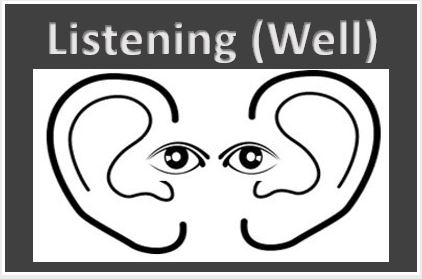
Most of us assume that listening is same as hearing. From a technical perspective, hearing is the processing of the sound waves as they traverse through the outer-middle-inner ear and then via the cochlea stimuli to the brain neuron sub-systems. From there, by magic, it flashes into our consciousness and we hear the sounds. Listening is the next phase of hearing. We process what we have heard, and respond as necessary. Without active listening, there is no value to hearing, as the process is incomplete. Often/most times we are not really listening but only hearing. From a Transactional Analysis perspective, this results in an incomplete transaction/interaction, and a feeling of “not being heard” by the speaker
All the 5 primary human senses, (Sight, hearing, taste, smell, and touch) are “inputs” and are a part of listening. But Sight and Hearing are tightly aligned to the listening process, for all humans. In a broader sense, listening is processing more than the Hearing sensory inputs – all sensory inputs are telling us something – we have to learn/evolve to listen to them. New born babies, in their early stages listen, using whatever input senses have evolved and are available for them to survive in their new world. As we mature and grow, Sight and Hearing become the primary inputs to the Listening process.
Why is good listening so important? In our personal and professional lives, our interactions and good listening/responding, means everything. We have to listen with our eyes and ears. The unspoken word and body language is probably more important than the spoken word. The person you are interacting with, is often saying one thing and thinking another. You hear – ‘listen’, to the spoken word, while your sight – ‘listens’, to the body language, the nuance of the words, and often the real message. A good listener, will never fail to listen and respond to the unspoken words, as without it your interaction is incomplete. Refer to my previous blog on Transaction Analysis. The visible transactions and the hidden transactions need to be identified. Often the Adult-Adult messages have other Parent-Child unspoken sounds in the background.
Often times, we stop listening, as we are trying to formulate a response at the same time. If you have not mastered multi-tasking this – you will end up in a failed transaction. Your need to tabulate in your minds, key points for your response….. as you continue active listening.
An important point to always remember is that listening does not mean agreeing. Active listening shows respect for your partner, and gives you the opportunity to understand their perspective – even if you completely disagree with them. If you are in a relationship where your partner is constantly, a poor listener – bring this up and resolve it, to avoid hurting yourself and your relationship.
Think about the multitude of your relationships and see which ones are great and where changes are required – from an active listening perspective.
 Life experiences to share....