
What is common between your Resume and a Product brochure?
- They are prepared for the express purpose, to help someone else make a “buying decision”
- They have to capture the attention of the viewer to read further, after a cursory glance
- The documents have to be brief, yet detailed enough to close the deal
- Both have to comply with the ‘truth in advertising’ laws
- Their prime objective is to highlight the positives and to make the “sale”
- And on, and on….. there are so many more commonalities
My point is that you have to remember this, when you first prepare (or update) your resume. The internet is flooded with examples of good resumes and folks who have made a career/business of resume writing. There are 2 aspects to any resume — (1) Content (2) Presentation. Good resume examples and career professionals, can definitely help you with (2) – although you alone, own (1). My belief is that there is no better person than yourself, to document your key selling points. Just as, only the Product Manager for a specific product, is the best person to prepare the Product brochure. Of course, wordsmithing may/will be required, by Marketing professionals
I mentioned above, the need for brevity. I have 35+ years of work experience – so how can I communicate my selling points for a multi-faceted career, and still be brief? My guidance is, focus on the last 7-10 years and provide sufficient details. For the rest, stay hi-level at the Organization/Roles/Products level and be ready to elaborate with talking points. In our current times, when technology/methods/SW languages change so frequently…. What you achieved 20 year ago, may not add direct value for your next job. It is still important to list every single job position and Organization you have worked at.
A key distinction you need to be aware of is, transferable skills (qualitative) vs absolute skills (quantitative). Your transferable skills are those that every job requires, irrespective of their actual products, systems or services. This becomes more relevant, with experience which strengthens your qualitative skills portfolio. Examples of transferable skills are – managing cross-functional teams, working in a start-up (fast changing) environment, handling large geographically diverse teams, selling under competitive pressure, etc. Surely, you need a portfolio of underlying, strong absolute skills. They help you to develop and establish your transferable skills – and provide the differentiation between competing candidates. Your list of transferable skills, should be your opening pitch in your resume to capture the reader’s attention. I have always used my transferable skills portfolio, as I have transitioned jobs between ‘different domain organizations’ – where the product/systems were completely different.
Often, you may tend to focus on your title/role/responsibilities in your resume, versus what value you added while working there. It is very important to list your Achievements (value-add) and not Responsibilities at all your previous jobs. Your ‘buyer’ wants to feel comfortable that you can replicate past behavior at your new job. A role, or title only partially communicate this, as roles tend to have different meanings at different organizations. Being a Principal or Distinguished Engineer at a large company, may be equivalent to a Director or VP level role, while at a smaller company, it may be more loosely used.
Every resume should have a header and a footer. The header should be less than 2 lines and document your Name, Mailing Address, E-mail Address and contact Phone number, in a font size slightly bigger than the document content. You want to ensure that every content page, carries your identity clearly. The footer should have Page No. and Date when Resume was prepared. For the main document, avoid using unique fonts and special characters. Use of standard fonts/sizes, is easy on the eyes and makes for focused reading
I would also recommend that you have a fixed resume (which you update every 6 months) and use a cover letter which is tailored to the specific job position you are applying for. It is not a good idea, to have multiple versions of your current resume in circulation, during a focused job search exercise.
In conclusion, I want to share (in the spirit of…… Life Experiences to Share) my most significant learning, over 7 job search exercises I have engaged in, over my career. The following is my creation – Career Timeline diagram.
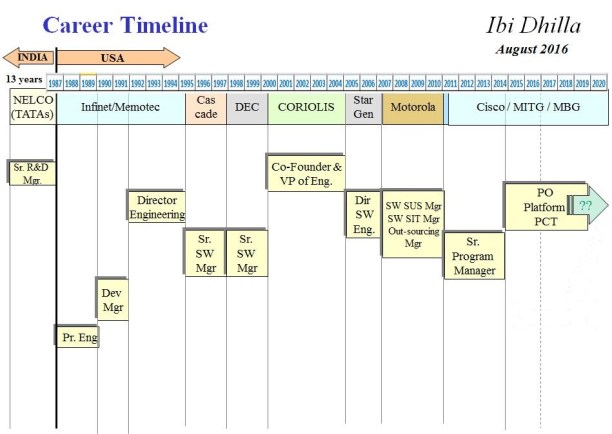
I created this, 25 years ago, when I first moved over to the US. It has been a great door opener, conversation starter and ice breaker, whenever I have met with my future managers. Rather than the interviewer (who is conducting the interview – in between meetings on a busy day) read through a verbose resume to talk to you…. A picture is always better than a thousand words. In one glance, the interviewer gets a complete picture of how you have progressed over time, etc. Of course, your resume is still necessary to fill in the details. My suggestion would be to update your Career Timeline as often as you update your resume. Never attach the Career Timeline to your resume….. always hand it over to your interviewer, as he walks in and you introduce yourself.
I am always available, if I can help someone on this subject…. Else, happy job searching. Remember, start from a position of strength in your search. Don’t wait, when you have no option, but to find a new job. Employment is always “at will” and you control your own destiny. For more reading material on this subject, refer my earlier post on Changing Jobs
 Life experiences to share....