
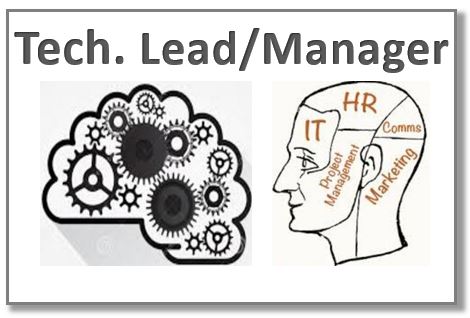
In the field of Software Engineering, for Individual Contributors, the next step in their career evolution is Technical Lead, followed by Technical/Development Manager. This may not apply to everyone – I know of several Engineers who have made a career choice of staying as an Individual Contributor, throughout their professional lives.
The transition from an Individual Contributor (IC) to a Technical Lead (TL) is more intuitive to follow. After several years of successful contributions and being recognized as an “expert” in a specific field – an Individual Contributor may be elevated to operate as a Technical Lead. In this role, they become the go-to person for the team ICs. A TL has IC responsibilities along with oversight and guidance of other ICs. For most ICs a career growth aspiration is to be promoted to a TL.
In my perspective, the tricky transition is the next career move from a TL to a Technical/ Development Manager (TM). A TL primarily has technology management responsibility, while a TM is a people manager, who is responsible for a team of ICs and TLs. The TM role requires oversight of day-to-day issues, performance, PTO approvals, annual assessment and one-on-one regular meetings and career guidance sessions. A TL does not own any of these functions and hence is not required to have specifically developed skills to deal with them. It is important not just for Organizations, but also for the Individuals, to understand the role differences here.
My experience indicates that most Organizations and Executive Leaders fail to understand these differences. A manager level promotion is a way of rewarding someone and is the Organization’s expression, that an employee is a valued employee. A TL often wrongly assumes that his reward and recognition requires a promotion to a TM. A Manager title implies a set of societal perceptions, which many professionals crave for – this skews their career growth path. Some TLs recognize the role differences and go through the necessary career growth training to move into a TM position. Organizations need to recognize these role differences, and reward TLs, via a technical career path (offering equivalent benefits) if they so choose one, or do not exhibit the right skill sets to function as a TM. I have operated as a TM in multiple levels and organizations and would like to clearly state – it is a difficult role, where you multi-task every waking moment and balance conflicting priorities and personnel/business needs. SW Engineers/ICs are amongst the most difficult group to manage and motivate, as they are all very astute and independent thinkers.
In several instances, I have seen a TL incorrectly moved to a TM role. This is not a ‘learn on the job’ kind of role and it results, in a lose-lose situation for everyone. Inexperienced Management is sometimes perturbed, when a brilliant TL is suddenly operating at a sub-par level when moved to a TM role.
Bottom-line…. If you are an IC transitioning to a TL – be cognizant of the TM role. Is that the path your career needs to traverse, OR, should you follow a pure technical growth path? If you are in a management role, responsible for considering such career options for your team – do not use the trivial path of promotion to a TM role, lightly. Consider closely the aptitude/skill set differences between the TL and TM roles, for the individual. What does your team member really see as their future career path? If your goal is to reward them, then there are more options than just a next level promotion to TM.
 Life experiences to share....
Nice thoughts !
LikeLike