
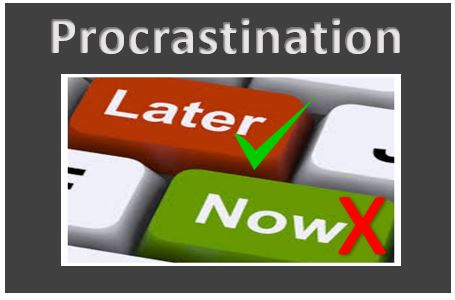
At some point in time all of us have procrastinated, and put things off. This should not be new information for anybody. The origin of the word has Latin roots, and describes it completely – pro (== for) crastinus (== tomorrow/day after). Essentially, it means that we do what we like/enjoy doing, versus the important, often hard tasks – which get deferred.
The ‘things’ we have on our to-do list, fall in the following four categories:
- They are important as well as urgent
- They are important, but not that urgent
- They are not very important, but urgent
- They are neither important, nor urgent.
Procrastination applies really to (1) above. (2) and (3) are judgement calls, on relative importance and urgency. (4) is, where we all love to spend all our free time on – and what is our default actions, as we procrastinate away from (1) and (2). Think about your last weekend. How many of your actions were (4) versus (1) or even (2) and (3). It is easy, and a no-brainer decision to do (4)
Requoting from my previous blog – Savings for Sunset …. A famous Indian poet/saint, Kabir (Kabir ke dohe – Kabir’s couplets) taught his disciples, via couplets:
Jo kal kare, so aaj (Translated: What you plan to do tomorrow, do today)
Jo aaj kare, so ab (Translated: What you plan to do today, do NOW)
Kabir was a 15th-century Indian mystic poet and saint whose writings influenced Indian culture, particularly Sikhism. He enlightened us on how to conduct ourselves, to fight procrastination. Six centuries later, his teachings are as applicable and still very relevant.
So why do we procrastinate? Everyone does, to some extent, so clearly we must be wired to respond this way. The reasons for procrastination will be different for everyone. I believe the following reasons may explain this behavior:
- Genuinely, some do not understand the importance/urgency of the task and are unaware that they are procrastinating (clearly this is a minority reason)
- For some, who work well under pressure – they prefer to put things off to the last possible time. In this case, this may be a managed situation, rather than true procrastination
- For some, they understand the gravity of the task, and are insecure of their ability to execute and are concerned about failure. I term such folks – PASSIVE-P procrastinators.
- The last category is clearly those who understand the importance and urgency and have just got into a “bad lifestyle” of putting things off. Instead, they justify (“I don’t feel like it) and do other more enjoyable tasks. These are the true or ACTIVE-P procrastinators.
(3) Above often is a subconscious process, driven by an innate fear of not performing. Hence my reference to this as PASSIVE. PASSIVE-P types are often so concerned about their performance on the task execution, that they put it off….. Putting off a task automatically eliminates the potential of failure and avoids the ‘insecure’ condition.
(4) Is the worst form of procrastination, and is being irresponsible. Hence my reference to this as ACTIVE. A study done by Psychology today indicates that 20 percent of people chronically avoid difficult tasks and deliberately look for distractions, making them ACTIVE-P.
If you happen to be, either a PASSIVE-P or ACTIVE-P type person – you clearly need to do some introspection and change your behavior. In both the cases, there is often a deep sense of self-guilt, as the deadline nears – and you know that you have a pending action. This self-guilt, results in other undesirable feelings and negative behaviors of the I am NOT OK category.
So recognize how and why you procrastinate, make conscious decisions to change and you will find that your rhythm gets more regular, life is more serene and things are in control. If the great poet/saint (Kabir) preached this in the 15th century…. Moreover, the condition still lingers in the 21st – it clearly is a problem that needs to be addressed, and further procrastination in this case will not help.
 Life experiences to share....