
As per Wikipedia definition – Entrepreneurship is the process of designing, launching and running a new business, which is often initially a small business and the people who create these businesses, are the entrepreneurs.
This is probably what comes to mind for most of us, when we hear about Entrepreneurs, in the developed world and hi-tech industries. I would prefer to label this definition as “Business Entrepreneurs” as one of their key objectives is wealth generation and creating new businesses and jobs. This category of Entrepreneurs is limited to those who are highly skilled/educated or have access to significant funds and opportunities, to start new businesses.
In the simplest form, Entrepreneurship means, one does not work for someone else to earn their livelihood, but they devise new ways of providing services via business or otherwise to support themselves.
In my recent trip to India, I was struck by another breed of Entrepreneurs – whom I would label as “Survival Entrepreneurs”. What do I mean by this? By sheer definition they are Entrepreneurs – but not driven by lofty goals, desire to succeed and to become wealthy; just to survive, day after day.
India, like most developing countries has a significant uneducated population base in a hi-tech job, industrial environment. A large segment of their citizens cannot be ‘gainfully’ employed and must fend for themselves. Either, because they have failed to educate themselves or were unable to do so; they enter their adult lives and must figure out how they will earn their livelihood. What they have going for them is their ability to work long and hard, driven by their desire to provide for their families, and belief in themselves.
We tend to overlook the Survival Entrepreneurs and accept them as a necessary part of the social fabric. We take their presence and contributions to our daily lives for granted. In most cases, society will not function or operate without them. Think of them as the thousands of small cogs and gears in a complex machine, w/o which things would come to a grinding halt.
Survival Entrepreneurs often have acquired/learned some special skills, from their parents; OR, have worked for years with a professional and acquired special skills. This helps them provide value, which they sell as services directly, to consumers. Examples would be cobblers, plumbers, carpenters, cart vendors, tailors, household help/maids, painters – and several hundreds more. Their goal is not to build a big business, although a small %age may evolve to that stage. Their ONLY goal is to sell enough of their services in a working day, to support their families, in a minimalist manner. Unlike the Business Entrepreneurs, they do not aspire to be rich and build a big business entity. All they want is, as we say in India – Roti/Kapda/Makan translated to Food/Clothing/Shelter, and a better life for their children
The reason why Survival Entrepreneurship is the ONLY way out in India and other similar situations is that unlike in the US – there are no food stamps and financial assistance for the unemployed or the under privileged. They have no other options. Either they find a solution to their problem, or they go hungry for days. Begging is an option for a small %age, although most would go to sleep on an empty stomach, out of self-respect.
I decided to spend some time and meet with a few of them, to get to know them and tell their stories. Here are stories of just 2 of them in action:
Roadside Cobbler:
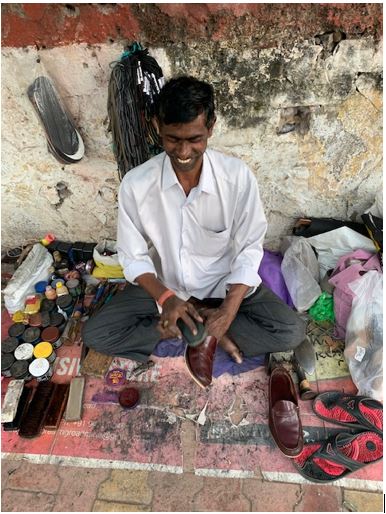
His name is Vijay (which means victory in Indian language) – I guess his parents wanted him to be a winner. I focused on him, as I have seen him in the same spot for at least 25 years whenever I have visited Pune; day after day providing a valuable service. Rejuvenating footwear of any kind – and adding new life into what in our western society, would have ended right away in the dumpster/landfill. He has a spot on the sidewalk of a busy road in East Street, Pune. He is there, 6 days a week from morning 9:30 am to evening 6:30 pm. He takes home every day his main tools and repair material in a bag; which he brings with him every morning. Unsure how the local authorities have not asked him to get off the sidewalk. Perhaps they are aware of the valuable service he provides. Based on my assessment, he probably takes home not more than INR 2000 (approx. US$ 30) every day. I marvel at his attitude, spirit and smiling face, given that there is no guaranteed take-home salary, however minimal at the end of every week.
I have this favorite pair of brown patent leather shoes, that I have become used to for the last 10 years. Before I left the US, I did notice that the sole of the right shoe had a small hole due to wear and tear. My normal next step would have been to discard them and buy a new pair. As I was going to be in Pune within a week, I decided to wear them and perhaps, get them repaired.
I visited him and he looked at the defect and with a can-do attitude, promptly offered me 2 solutions. I took the one which he could complete in just an hour for INR 200 (US$ 3). The picture I have of him above, is when he finished resoling the shoes and was giving a free coat of fresh brown polish to make them look as good as new.
At the end of it all…. I supported a Survival Entrepreneur to earn an honest livelihood and got myself a reconditioned pair of my favorite shoes for under $3. Clearly a win-win situation.
Street Cart Seller:

This is one example of a street cart seller – a clothing ware seller. Other cart sellers may have fresh vegetables, fresh fruits, etc.
I have seen this cart-seller everyday 7-days a week in the street below, at a family member’s home in busy Center St, Pune.
What amazes me is the wide variety, sizes of children and adult clothing, socks, slippers, caps, sweaters, outerwear…. You name it – and he will have it. There is another set of specialists, who repair and build the sturdy carts for the cart sellers. That is another story, for another day.
He comes in to work, pushing his loaded cart with his merchandise around 11:00 am and is selling his wares till 9-10 pm. He has carefully understood his customer’s needs, as he always has a crowd, wanting to buy from him. His customer base is mainly middle class to lower middle class – who clearly find competitively priced clothing ware at his cart, for the entire family in one spot. He has no overhead costs, so compared to other clothing stores, he can be very competitive.
He works alone and as I would watch him from above, seldom lets a customer walk away. He will find the right ware they are looking for and negotiate the lowest price. 90% of the time he will close the deal.
Unlike Vijay the cobbler, this person is a ‘reseller’ of clothing ware. So, he has purchase costs to deal with and a profit to be made. Perhaps some MBA student should analyze the business case here, the economics of his business. Clearly at the end of the day, with razor thin profit margins – this person has managed to use volume to his advantage to make a living. He has no formal education and has managed to make a business out of reselling clothing ware from a 4-wheeled cart, profitably.
In closing, I want to recognize this class of businesspersons (men and women), the world over. Without their contribution, society would not function. At their operational scale they do have successful businesses, compared to the Business Entrepreneurs and deserve the same level of respect and credit.
 Life experiences to share....