
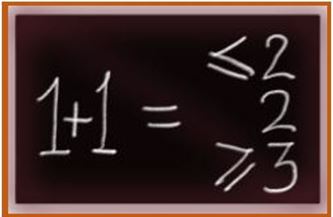
My question appears to be a KG grade arithmetic query. Let us dwell on this a bit. If only – our lives and the issues we are confronted with every day, were as simple as what is (1+1) equal to? Your (1+1) could be a reference to anything you do. It could be related to facets of your personal or professional life, your passions/aspirations (and gap with reality), etc.
What do I mean by the 3 equations in the graphic above?
When (1+1) ≤ 2
- This category includes all your actions which leave you with a feeling of “lesser than before”. You have done what you started out to do, or what you were asked to do, or are obligated to do – But once you were done, you did not feel good about what you just did. On the contrary, the dominant feeling at the end is, you could have used that time more effectively doing other things. You do not want to do these tasks – but feel you are between a hard rock and a wall; and you have to do them
When (1+1) = 2
- This category includes all your actions, which are sort of “mindless” and you do them, as a part of your lifecycle routine. The bulk of our actions generally fall in this category. Most of our life is spent, zombie-like, in this zone. We do these routine tasks, with no expectations as we believe it is our responsibility to do them. These could be tasks at home (for the non-working spouse), or your 8-hour a day work duties.
When (1+1) ≥ 2
- This category is what we live for. It is our passion….. The larger the ≥ factor, the more intense is our feeling of “greater than before”. Think of your time/actions when you get immense joy, after you are done with something. We look forward to this time and often – manage to survive through the ≤ and = phases, in anticipation of the ≥ phase. There are fortunate few amongst us, who get to live in this phase for most of their lives. I feel happy for anyone who has achieved this state of nirvana – where they are living every minute, doing what they are passionate about. In this case, either your profession and passion totally overlap, or you are amongst the fortunate few, who can follow their passion without the need to work for a living.
The most unfortunate amongst us as a matter of survival, stay stuck forever in the ≤ and = phases. They do not have the wherewithal to be able to break out of the gravitational pull of their daily lives, and even dream about the ≥ phase. Let’s leave this thought aside, and focus on what is feasible and possible for most of us – who are more fortunate.
Most of us are so involved and intertwined in our day-to-day existence – that we dare not even think of what makes us happy, and feels good. The ≤ and = phases, consume us and we procrastinate and put off all ≥ stuff we’d love to do – for another day, sometimes when we are done with our current unfulfilling tasks. Life is short…. As a wise Indian poet who preached via couplets, called “Kabir ke Dohe” once said:
Jo kal kare, so aaj — What you plan to do tomorrow, do today
Jo aaj kare, so ab — What you plan to do today, do NOW
Find your passion and more important, find the time to execute on your passion. Think of what you enjoyed and loved doing when you were younger and were a ‘free’ child. Most of what once brought you immense joy still is your passion. One never loses their passion. They just bury it way below a lot of so-called grown-up responsibilities. The ‘free child’ in you unfortunately grows up to be a ‘captive adult’. Oftentimes we feel guilty about spending anytime on feeling good, as we are expected to be more responsible and ‘grow-up’ as adults.
Remember – it is your decision to follow your passion. You will be surprised how your schedules will adjust; tasks re-prioritized to free up time – once you decide to follow your passion – and make the choice to feel good. Also, it is the little things that often count and will make a difference. We forget about them, and focus instead on the Mount Everest’s to climb. Your bucket-list entries (if you have one) may also be a good place to look at for pointers
This is one equation in your life that is best to get wrong mathematically – and ensure that the ≥ phase factor is as large as possible. Assess this in your personal as well as professional life. We spend as much time working, as we do with our personal family lives. Once you have achieved this unbalanced equation and defined all the right parameters to ensure the right side of the equation is always ≥ the left side, the sun will always be shining in a bright blue sky for you.
 Life experiences to share....