
In my research on this topic, I came across an interesting URL link – which provided a simplistic definition of the 4 types of Intelligence, used as a true test of success in the modern workplace:
QUOTE:
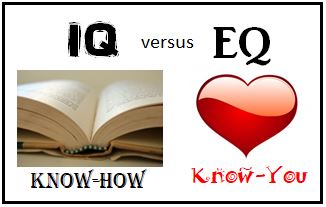
IQ or Intelligence Quotient -The intelligence, knowledge, facts and trivia that one possesses.
EQ or Emotional Quotient – The emotional understanding and capability of oneself and others that helps with differing situations and people.
AQ or Adaptability Quotient – The ability to adapt to and thrive in an environment of change.
SQ or Social Quotient – This is a measure of a person’s ability to build a network of friends and maintain it over a long period of time.
UNQUOTE:
In this discussion, I’m focusing more on the IQ and EQ components as the dominant quotients that apply to one’s general life, rather than just the workplace. AQ and SQ also matter in one’s personal life, although a strong EQ, compensates for them in day-to-day interactions
From the time one is a child, till one grows up through teenage years to early adulthood – there is an exhaustive focus on the IQ component. Children grow up being compared to other kids, in an effort to motivate them to do better. Parents are constantly going by metrics of scores, ranks, grades, and percentages. Unfortunately, our entire education system’s goal is to find out who, amongst their students, is in the top 10-20 percentile ranking. Schools pride themselves on which Ivy League colleges; their top students get admitted to. Children grow into Adults being indoctrinated to wear their IQ metrics on their shoulders as a badge of honor. I have the highest regard for the best and brightest amongst us – as they often bring the most significant changes in our society. My issue is with the fact that although IQ is necessary; it is NOT sufficient for success. We completely disregard the EQ component which is never considered or nurtured as a Child evolves into Adulthood. (IQ&EQ) both are required, necessary, and sufficient for a successful adult and professional life.
Colleges and graduate/post-graduate schools continue to promote this paradigm of IQ focus and cement the trend further. Their business model needs the brightest in their research labs, to discover new methods and processes on behalf of their Alma Maters. Again, I understand this and endorse it completely. My gripe is that all through the growing-up phase – till early adulthood; when one is ready to enter the workplace – there is little to no emphasis, on ensuring that this bright individual can survive and thrive in a competitive workplace with real disparate people and their subjective opinions. Their quiet island of existence will soon become a crowded noisy neighborhood.
My belief is that we should not and cannot discount the EQ component development along with the acquisition of IQ skills. Knowledge (IQ) can always be acquired at all stages of our development, for most of us. EQ is more foundational. It is like a core component and defines one as an individual. Just as it is difficult (if not impossible) to rebuild the foundation of an existing building – EQ cannot be ‘layered on’ to complete an individual once they have grown up and are functioning adults. Either you have EQ or you do not. If there is no focus on nurturing EQ in one’s formative years – then this statement is very true. If you do not have even basic EQ, all your effort in acquiring a dominant IQ will face shortfalls in real life.
During the hiring process at most companies, HR’s focus is primarily on the ‘measurable/ quantifiable data’ of past experiences and educational qualifications. The EQ measure is seldom a focus, except in some rare cases of enlightened hiring managers. EQ measures are qualitative and need insightful discussions to surface them from the depths of the individual’s consciousness, during the interview process. If the position being hired for – requires significant ‘people management’ then it becomes even more critical to gauge the EQ measure vs the IQ measure. Even in an operational organization – the emphasis/rewards always focus on tangible goals; like further education, specialized technical training, patents, etc. Very few organizations ever focus on the EQ health of their key stakeholders/contributors.
Parents specifically need to focus on this qualitative quotient (EQ) as their children grow up. They must encourage social interaction and the development of skills of co-existence and cooperation even with friends they may disagree with. Skills, like emotional abilities and social skills, including cognitive empathy, emotional regulation, and motivation must be nurtured and encouraged. As children are in their formative years, besides books-based education they must be provided the opportunities to develop their EQ skill sets. If the right seeds are planted at the right time and nurtured with caring attention, they will blossom – as children evolve into young adults and flourish in society.
 Life experiences to share....