
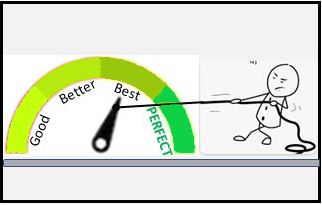
Is PERFECTIONISM your enemy, impacting your Good/Better/Best? This question is equally applicable to our personal and professional/work lives.
Perfectionism, like evolution, is a continuous and never-ending process. We, human beings are still evolving and no one is perfect.
All of us always want to achieve the best, in whatever we are doing. So my question is, are you always stretching yourself to achieve perfection? At the cost of other tasks you could have achieved in the same time; versus just doing your best, or a great job?
If you are a Type-A personality, your drive for being very organized, goal-oriented, and competitive will often push you to the elusive target of being perfect. Then again, achieving perfection is very subjective, although the mathematical answer is very objective, precise, and unachievable.
Objectively, Perfectionism is always 100%. I believe 99.9% or sometimes even 99% is a real-life better/best end goal, versus chasing the elusive 100%. To theoretically reach perfection – T=Infinity (or a very, very long time) as shown in the graph below.
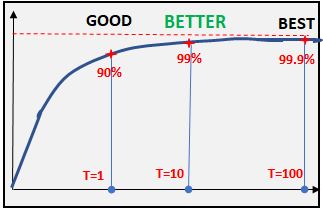
Most of us are generally fine with the Better/Best option, as we multi-task our way, through our complex list of daily personal and professional workloads.
Consider the concept of ‘realistic Perfectionism’. The measure of any task being ‘complete’ is generally subjective – whether it is SW coding, Marketing PPT material, gourmet cooking, canvas oil painting, sculpting, etc., etc.
Nobody (very few) will start a task with the goal of not doing their best – or, just wanting to get it over with. However, there are some tasks, like doing the laundry, mowing the lawn fixing the light bulb/appliance, etc. – which do not qualify for what I am referencing here. These mundane tasks are almost involuntary and they just need to get done 😊
At the same time, there are other tasks like competing in the world Olympics sports events – where the only end goal is being perfect – getting a score of 5.0 in floor gymnastics, hitting 3-pointers 9 out of 10 times in a finals basketball game, or shaving off 0.05 seconds in the finals 100 meters dash. Folks who are skilled enough to participate here are in a different class. They practice intensely for years, to develop muscle memory, which allows them to chase the elusive goal of perfection.
For us mere mortals, we need to clearly understand subjective Perfectionism and the need to stop doing a specific task beyond the best and move on. Save on your opportunity costs and achieve other ‘better/best tasks” versus the “one perfect task”
This behavior of being super picky about something and finding it so difficult to get what’s “just right” is also referred to as the Goldilocks Complex. It is like the children’s story of Goldilocks and her porridge, or the bear beds.
This ‘subjective Perfectionism’ practice is very much applicable to the professional business world. In a Management training seminar, I learned that the most successful product in any Market is never the ‘perfect’ one, but the one that ‘best’ solves customer problems. The ‘perfect product’ is always being innovated upon continuously, and is never ready. Oftentimes, it is better to ship a product/release with known/benign issues, than delaying its release till all issues are fixed – at the cost of lost revenue/market opportunity. No Customer in the hi-tech space expects a ‘perfect’ product/release. Yes, they do expect that there will be no business-impacting issues that cause downtime in their service offering – a.k.a. subjective Perfectionism.
In the late 70’s and early 80’s – we were used to the command-line interface offered by all operating systems and the only graphic images we used were all ASCII character-based.
Those of us who have lived through this – have seen the early market dominance wars (the mid-1980s to 1990s) between Apple (MacOS) and Microsoft (DOS/Windows).
| Timeline | Apple (MacOS) | Microsoft (Windows OS) |
| June-1984 | MacOS 1.0 | — |
| Nov-1985 | — | Windows 1.0 |
| 5-6 year period of intense competitive MacOS and Windows Releases | ||
| May 1990 | — | Windows 3.0 |
| May 1991 | MacOS 6.0.8 | |
| Apr-1992 | Windows 3.1 | |
| Aug-2009 | MacOS 10.6 | |
| Oct-2009 | Windows 7.0 | |
View the above table – to see how Microsoft made the right calls to release early versions of (imperfect, close to crappy) Windows OS versions in 1985 and 1990, to keep their foot in the door and prevent mass migration of their command-line user Customers to the ‘next generation’ graphical user interface Apple MACs. Clearly, if Windows had waited 10 years before a really usable competitive GUI/mouse-based OS (Windows 3.1) was available – we would all be using ONLY Apple MACs, today. 2009 is the timeline when both the giants released stable, very functional competitive OS’s and decided on a path of peaceful co-existence.
So forge ahead and do your best in everything you undertake – without second guessing if it is perfect or not. Perfectionism is a mythical concept and just a word in our vocabulary.
 Life experiences to share....